-- Newsletters --


Free Newsletters About Tinnitus!

Enter your Email


Masking For Symptomatic Relief

A sound with higher decibel can mask the low decibel sound of tinnitus. This can be illustrated below:
Sound from surrounding Environment: A TV programme running in the background is often helpful when the tinnitus is disturbing.

Some examples of masking due to environmental sounds are:

Playing with friends, surfing on a beach, festival and other celebrations.

A "Walkman" or “Ipod” can be used with plug-in-ear earphones; which can be switched on when resting.

Modern hearing aids incorporating latest technological advancement are very effective at submitting the usual soft environmental sounds around you, and helping to get tinnitus mask. Older aids were not useful for this purpose. They can be programmed to amplify the whisper like sound around you without amplifying loud decibel sounds (thus avoiding noise induced hearing loss), and thus mask the annoying unwanted irritating tinnitus sound.


Tinnitus maskers : They are not hearing aids in true sense but generate some pleasing sounds in the ears which are not disturbing. They in no way can be used for people with hearing loss. But its use for masking is very limited as most of tinnitus affected age group are of old age with hearing loss and so hearing aid is a better option..

Thinking, Emotions and Tinnitus

Let's say that someone decides to discover the cause of his tinnitus. He already passed all diagnostic, which discovered no organic base, so it obviously has something to do with his life attitudes: habits, relationships, understandings...

In desire to find a solution he can use: thoughts, logic, emotions, consciousness.

Thoughts: 'I can try that drug...or...The traffic under my window causes my tinnitus...I will find solution alone, I will never..., I have to say her...' Thoughts are many, can be confusing. It is good to find good thoughts....

Logic is finding a correlation between thoughts, events. 'If that tea didn't help to others, will also not to me...'

Emotions: anger, peace, fear...are excitations of the heart. They always appear as heart's response to an event, a thought... Emotions disappear after a while. They can give a taste to our life and help us.

Sometimes is good for us if we are persisting in particular emotins, sometimes is not. How to distinguish this?

Intuition is commonly described as 'power of knowing without reasoning'. It can be compared with consciousness. Consciousness has two meaning: a - awareness, b - a voice which tells use what's right.

With awareness part we can observe and see that particular thoughts revoke particular emotions. We CAN find out what causes peace in us. But peaceful feeling can be tricky. True peace is permanent. This doesn't mean that we will feel a permanent emotion. It means that whenever we check our plans we will feel peacefully if the plans are good and we will lost peace in time if our plans are bad.

There is a voice on the end which will tell us 'yes' or 'no' (to do something).

We don't need to understand that voice. If we find peace with that voice it is enough to listen it and do what it tells us.

Tics, Tinnitus, Tremor...

Tics, tremor, nistagmus, tinnitus, cramps...
...can all appear as standalone symptoms or as a consequence of a proven disease.

Tics are uncontrolled muscle twitches or sounds (blinking, clearing the throat, grimacing, sighing...). They can appear at 3 years and are often prominent between 9 and 13 years of age. They can be aggravated by stress, anxiousness or drugs like Ritalin in Attention Deficit Disorder. They can be part of Tourrette's syndrome which runs in families, but it still hasn't a clear cause. Tics in most cases vanish until early adulthood.

This occasional and stress related nature of tics strongly suggests a psychic origin. But it is also interesting how tics stop - children being solved their psychic troubles or not.

Tinnitus on the other side usually starts in adults.

Few tinnitus sufferers had tics in childhood. It seems that the cause - which is obviously not organ-fixed - remained, only the symptom changed. Other symptoms with possibly psychic origin: tremor (as shaking or shivering), nistagmus (rapid eye movements), behavior or speech disorders, depression, anxiousness, asthma, allergies, phobias, panic attacks, cramps, palpitations, digestion/bowel problems, peptic ulcer, headache, migraine, backache, muscle/bones pains, angina pectoris.

Low Blood Pressure and Tinnitus

When you get up from the bed in the morning, do you hear a hiss within your head (or in the ears)? Do you feel like you'll faint?
It can mean that you have a low blood pressure (BP).

In healthy adults BP is between 140/90 and 90/50 mm Hg. Normal BP level varies from person to person, so more than absolute value the change of BP level is important. Fall of BP for 20mmHg in a short time can cause hypotension symptoms even if the absolute value of BP is within normal range.

How low BP causes a hiss?
Low BP leads to low pressure within the head (intracranial pressure) consequently changing the pressure in an ear cohlea fluid (endolymph), which affects the normal way of stimulation of hearing receptors what results in a hiss. In addition: blood supply to inner ear vessels is not sufficient what results in inappropriate operation of the inner ear.

Other causes of hiss related to vessels/blood:
High blood pressure
Atherosclerotic artery or thrombotic plug in veins near the ear causing turbulent blood flow.
Brain artery aneurysm
Changes in blood composition (anemia, leukemia...)
Dehydration

Psychosomatic Pain vs. Tinnitus

Pain is considered as a helpful sign in medicine. It tells us there is something wrong with our body or with our life...It suggests us to check and remove the cause.

Pain can be a consequence of a disease arising from the body or from environment (e.g. ear pain from noise).

All other causes of pain arising in person's relationships, memories, life attitudes...are referred as psychosomatic. Headache, migrain, stomach pain and backache are examples. Tinnitus - felt as pain or not - can fit in this group also.

These pains are not imaginary, they are true. If you feel tense, muscles will be tense and if this lasts for some time, the pain will be felt. Excessive activity of an auditory nerve caused by psychic tension is a physiological explanation for the tinnitus, where no other causes are found.

Have you ever experienced a headache after sitting in the front of a computer for a long time? I think that such a headache is a nice warning that you are doing something bad to your eyes and to your life maybe. Thus the solution (on a long term) is not in taking some analgesics, but to make a break, go to sleep or on a walk. And to consider - is it O.K. that I use computer so much?

And have you ever experienced your eardrum is twitching in an exciting situation where you were feeling that you were doing something wrong?

What can Affect Hearing Process

I will explain here a hearing process and what can affect it.

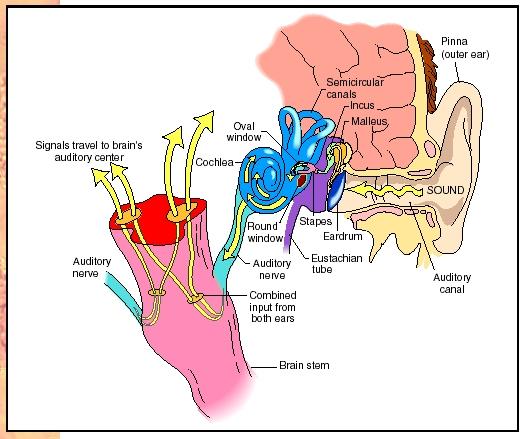
Sound waves come through ear canal, reach eardrum and swing it. Vibrations are carried via three hearing bones (in the middle ear) toward the cohlea and causes the liquid within to oscillate. This stimulates hearing receptors. At this point mechanical vibration is converted in nerve excitation which propagates via auditory nerve through brainstem and reaches the brain. Excitation of brain cells in auditory area is recognised by a person as a sond.

**At all this points a sound can be impaired by objective and subjective causes**.

Objective causes:
A
foreign body, injury, infection... in ear canal.

Any procees which press on auditory nerve on his path toward the brain
.
Changes within the auditory nerve
.
Vascular (aneurysm) or blood disturbance (thrombosis, policythemia).

Subjective causes:
Psychic tension, Pain...
Tension can cause the muscles in the middle ear to contract, which can objectively affect the perception of loudness.

All these causes can not only prevent hearing but can also distort a sound or can pruduce tinnitus.

Sound related Terms

The Sound is a propagation of vibration (with 20-20,000 Hz frequency) through the medium (air, liquid solid matters). It is a mechanical force which causes vibration of the tympanic membrane (eardrum).

Loudness of a sound is determined by pressure of sound waves puts on an eardrum. Measure unit is decibel (dB).
Hearing threshold is at 0 dB.
Normal Talking at 1m distance ...40-60 dB.
Major Road at 10m distance... 80-90 dB.
Prolonged exposion to 85 dB can cause hearing imparmient.
Short exposion to 120 dB can cause hearing damage.
Plane on the airport...120-140 dB.
Treshold of Pain...135 dB.

Hight of the sound is determined by frequency of sound waves.
High frequency means high sound.
The hearing range is between 20Hz to 20,000 Hz and it changes with age. Old people usually can't hear sounds over 16,000 Hz.
Sound out of this frequency range cannot be heard. Sound over 20,000 Hz is called Ultrasound, below 20 Hz is Infrasound.

Tone is a sound of a particular frequency. 'Middle C' has 262 Hz, 'high C' has 512 Hz.
Monophonic sound is composed from one tone
Polyphonic sound is composed from two or more tones.
Hiss is a sharp sibiliant sound like sustained 's'.
Noise can be defined as unwanted sound.
Resonance is a relatively high amplitude of vibration produced when a frequency of some source matches the natural frequency of other object.